
Objective 3.6#
LO# |
Description |
|---|---|
3.6 |
I can calculate the distance from a monostatic radar to a stationary target based on pulse timing, assuming a direct line-of-sight path. |
Radio Ranging Introduction#
The fundamental principles of RADAR are fairly straightforward – the system sends energy out into the world and measures what comes back. Based on the returns from the transmitted signal, the RADAR identifies where objects are and how far away they are. Additionally, RADAR is an acronym, standing for RAdio Detection And Ranging. Simply put, with RADAR we use radio signals to tell if anything is there (detection) and to tell how far away it is when we find something (ranging). Modern RADARs have many more capabilities that fall outside the scope of this course, but you’ll likely see it in your career (or in your higher level courses if you major in ECE).
RADAR Range to Target#
Calculating the range to a target is a fairly straightforward matter and uses basic physics principles. Since we know that electromagnetic waves travel at the speed of light, the amount of time between sending an energy pulse and receiving its echo is all we need to determine the range to the target. Note that this assumes your target it unmoving and your radar transmitter and receiver are colocated.
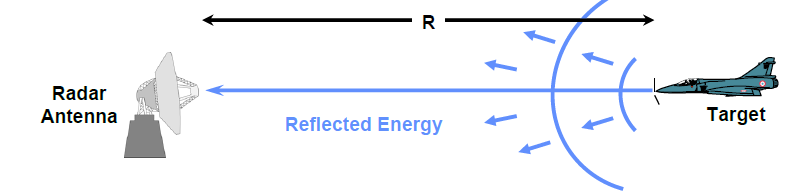
Figure 1: A basic RADAR scenario.
Therefore, if t is the elapsed round-trip time for the signal to travel to the target, reflect from it, and then return to the RADAR receiver, then the range to the target is:
where c is the speed of light. The factor of two in the denominator converts the round-trip time into a one-way time between the RADAR and the target.
Example Problem#
A RADAR signal returns 573.4 μs after being transmitted. How far away is the detected object?
Understand: RADAR signals travel at the speed of light, and we can determine how far they’ve travelled based on how long it takes them to make the round trip. It is important to remember RADAR involves a two-way trip.
Identify Key Information:
Knowns: The signal’s round trip time.
Unknowns: distance to the target.
Assumptions: We are receiving the signal directly reflected from the target and not one that has bounced around off of other objects.
Plan: We will calculate how far the signal travelled and then divide by two for the two-way trip.
Solve:
Answer: The object is 86 km away.