
Objective 1.7#
LO# |
Description |
|---|---|
1.7 |
I can calculate the efficiency, source voltage, and current of a power transmission system with one or more power converters. |
Understanding Power Converters#
Power converters are essential components in electrical and computer engineering, allowing electrical energy to be transformed to meet the specific voltage, current, and frequency requirements of different electronic systems. They are widely used in consumer electronics, industrial applications, renewable energy systems, and power distribution networks. Understanding how power converters work, their types, and how to select the right one is crucial for engineers working with modern electrical systems.
1. What is a Power Converter?#
A power converter is an electrical device or circuit that changes the form of electrical energy while maintaining power transfer efficiency. Power converters are necessary because different electronic devices operate at different voltage and current levels. For example, a laptop requires a lower voltage DC power supply, whereas household appliances generally operate on high-voltage AC power.
Power converters bridge this gap by converting electrical energy from a source (such as a power grid, battery, or renewable energy system) into a usable form for the load. This conversion ensures that electronic devices receive the correct amount of power while minimizing energy losses.
Power converters play a key role in the following applications:
Charging systems for batteries and portable electronics
Power supplies for computers, communication equipment, and industrial automation
Renewable energy systems such as solar and wind power conversion
Electric vehicle (EV) power management and charging infrastructure
Motor control systems for automation and robotics
2. How Does a Power Converter Work?#
Power converters function by modifying electrical parameters such as voltage, current, and frequency using semiconductor-based switching circuits. These circuits rapidly turn electrical signals on and off to control the power flow efficiently.
Depending on the type of power converter, different techniques are used to achieve the desired conversion:
Rectification: Converting AC to DC using diodes and rectifier circuits.
Switching Regulators: Using transistors to regulate voltage levels efficiently.
Pulse-Width Modulation (PWM): Controlling the duty cycle of a switching signal to adjust power output.
Frequency Conversion: Modifying the frequency of an AC signal for specialized applications.
By using these methods, power converters efficiently transform electrical energy with minimal losses, ensuring devices receive a stable power supply.
3. Types of Power Converters#
Power converters are classified into four main types based on their input and output characteristics. Given the ubiquity of AC-DC converters, this reading goes into much more depth for AC-DC converters than the other types of power converters. Those other three types are covered at a high level after the AC-DC converter section - don’t forget to read about them, too!
Note: power conversion work-out problems will be covered in class time. This reading details how power conversion works. See the Objective 7 lecture slides and practice problems for examples of work-out problems using power converters.
A. AC-DC Converters (Rectifiers)#
AC-DC converters transform alternating current (AC) into direct current (DC). Although transformers make it more efficient to transmit AC power over long distances, many devices require DC power to operate. Computers, for instance, need DC power to run all of the data processing circuitry that makes a computer useful. Even though we plug them directly into our wall outlets, they actually have built-in AC-DC converters to provide the necessary DC power. Furthermore, anything that runs off of battery power, such as cell phones or tablets, uses DC power. When we charge these devices, the charger converts an outlet’s 120 VRMS signal into an appropriate DC signal. In this section, we will explain how AC-DC converters work. This conversion is essential for devices like laptops, smartphones, and LED lighting that require DC power.
Basics of AC-to-DC Conversion#
The most basic AC-to-DC Converter is the half-wave rectifier. To understand how this type of converter works, we need to introduce two common electrical devices:
A diode is a semiconductor device that allows electricity to flow in only one direction. The light-emitting diode (LED) is the most commonly seen diode, but electrical engineers use diodes for many other applications. This device is basically a “one-way” valve for current to flow through. We can use a diode to convert an alternating signal into one that is ALWAYS positive (a process called rectification). This process is needed in AC-to-DC Conversion.
A capacitor is a storage device that acts like a temporary battery. If a voltage is present across the capacitor, it will charge up to that voltage. If the voltage is taken away, it will discharge if connected to a load. It is important to know that this charging and discharging does not happen instantaneously. For this reason, capacitors can be used to smooth the rectified signal.
Let’s take a close look at a general AC signal, starting at time t = 0 sec, and consider what is really going on with this signal.
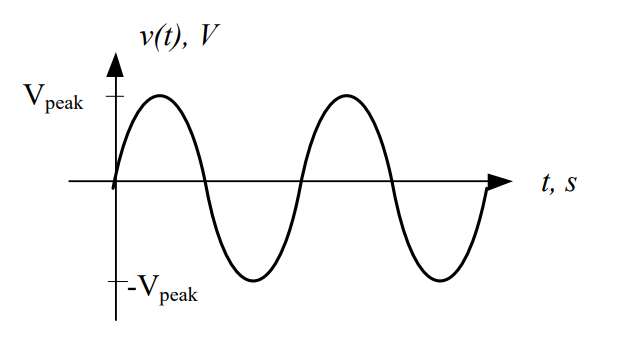
Figure 1: Voltage of a general AC signal
We can think of the voltage as a pushing force that causes electrons to move. When we first start on the graph at 0 ms, the pushing force of the signal is at 0V. As time passes, however, this pushing force begins to increase until it reaches its peak voltage. As time passes even further, the pushing force decreases until it reaches 0V, then turns negative and continues to decrease until it reaches its minimum. At this point, it starts increasing until it returns to its peak voltage.
Now think about the current this changing voltage would produce. When the voltage is positive, the pushing force pushes electrons through the circuit in one direction. When the voltage is negative, however, it becomes a negative pushing force, which pulls the electrons the other way. Push, pull. Push, pull. Push, pull.
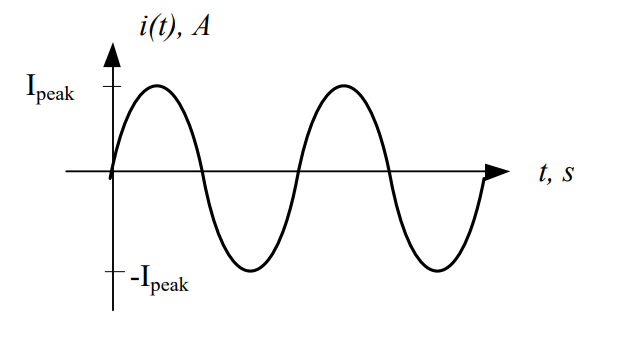
Figure 2: Current of a general AC signal
That’s why it is called an alternating current: it spends half the time flowing forward and the other half flowing back.
Key Point: Negative currents are just currents flowing in the opposite direction than expecxted, and negative voltages are just voltages that are opposite of the polarity shown on the device.
What would happen if we allowed this signal to pass through a diode, which only allows current to flow in one direction? As Figure 1Figure 3 below shows, the diode blocks the negative part of the signal from passing through, but lets the positive part continue. This occurs for both the voltage and the current.
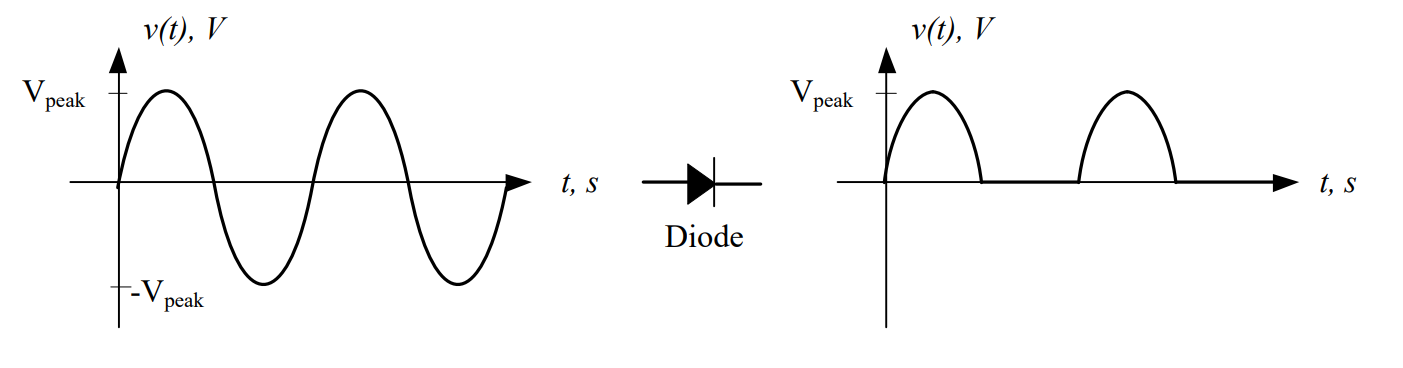
Figure 3: Voltage of a general AC signal before (left) and after (right) passing through a diode
Even though the signal coming out of the diode is not a DC signal, we’ve gotten rid of all the negative voltages, which means we’re one step closer. Instead of push, pull, the signal is now push, pause, push, pause. The signal is now said to be rectified, and more specifically, we can say the signal is half-wave rectified because only half of the waveform is allowed to pass. This is where we get the term half-wave rectifier.
The key is understanding that the signal at the input of the diode has an average voltage over time of 0V, while the output signal has an average voltage over time greater than 0V.
Now that we know how the diode affects the signal, let’s look at the effects of the capacitor and its contribution to the resultant signal. When adding the capacitor to the half-wave rectifier, the capacitor must be placed in series with the diode and voltage source, as shown in Figure 4.
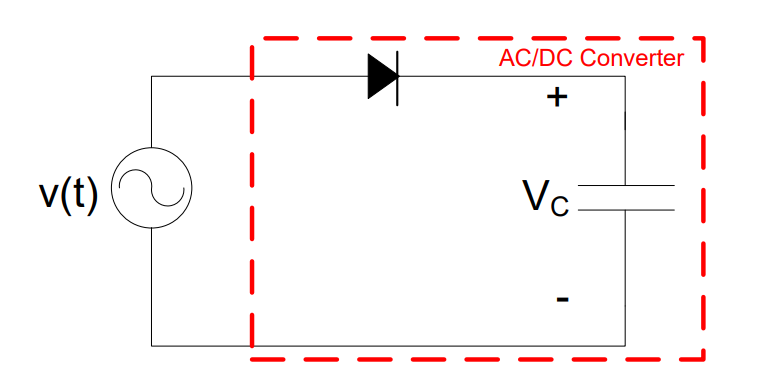
Figure 4: A half-wave rectifier without a load
As said earlier in this reading, a capacitor acts as a temporary battery. At “t1” ms in Figure 5, the output of the diode (shown as the dashed line) is at its peak. This voltage quickly charges the capacitor to the same value. Since no power is being consumecd by the circuit, the output—represented by the solid line—remains constant. Interestingly, capacitors do not consume power, but rather, they store power in electric fields. The specifics of this will be covered in more detail in Lesson 15.
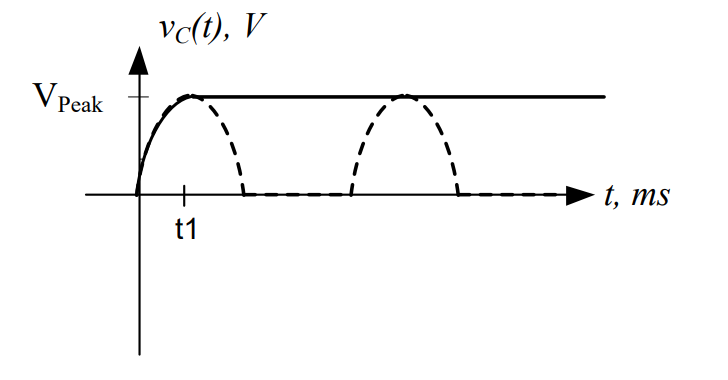
Figure 5: Voltage of a rectified signal (dashed line) and capacitor voltage (solid line)
In this ideal case, where the AC-DC converter is not supplying power to anything,
Now, in order to supply power to a load, we need to place the load (RLoad) on the output of the AC-DC converter. We do this by placing that load in parallel with the capacitor, thereby ensuring that the load gets the same voltage as the capacitor. This is shown in Figure 6. It is important to note that RLoad is not actually part of the AC-DC converter. Instead, it is the tablet, cell phone, or computer that uses the DC power that is created.
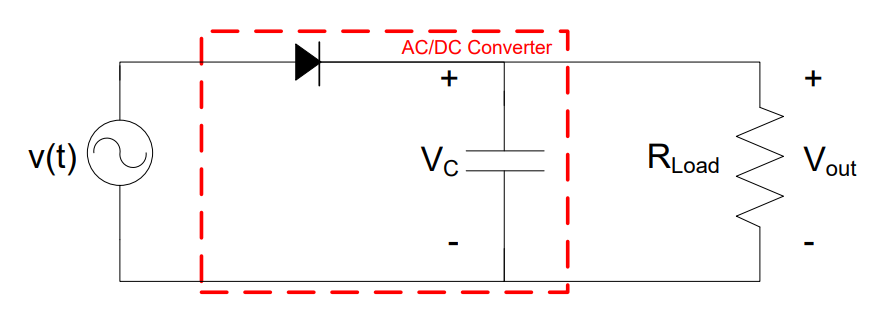
Figure 6: A half-wave rectifier with a load
At “t1” ms in Figure 7, the output of the diode (shown as the dashed line) is at its peak. As stated earlier, this voltage quickly charges the capacitor to the same value. In Figure 5, the voltage over the capacitor remained constant once it was charged up; however, that is not the case when a load is added to the output. When the output of the diode starts to drops off towards zero volts, the capacitor starts providing current to the load. This current pulls power from the capacitor, causing it to be consumed in the load. When this occurs, the voltage across the capacitor drops slightly, which means Vout also decreases. Next, the voltage from the diode reappears and climbs back towards its peak, charging the capacitor back up to Vpeak and continuing the cycle. We call this variation in voltage over time a “ripple”. The resultant output in Figure 7 is not a perfect DC signal, but it’s reasonably close.
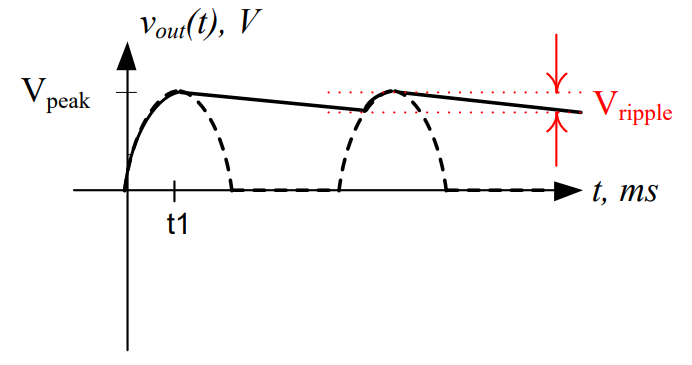
Figure 7: Voltage of a rectified signal (dashed line) and output voltage over a load (solid line)
The rate at which the capacitor voltage decreases is determined by two things: the size of the capacitor (bigger is better) and the magnitude of RLoad (a smaller RLoad means the capacitor discharges faster). A bigger capacitor can store more power, and a smaller RLoad draws more current from the capacitor. The bottom line is the diode blocks negative current (creating a rectified voltage), and the capacitor smoothes out the bumps.
AC-to-DC Conversion Block Diagram#
Before we look at AC-DC converters from a block diagram perspective, let’s summarize the overall process. It typically takes four steps to convert an AC signal into the needed DC format:
Transformation: While this step is sometimes optional, we rarely get the exact AC signal that we need for our AC-DC converter. We often have to step-down the 120 VRMS coming out of the wall outlet to more acceptable levels. Also, there are times where we would need a large DC voltage and will require a step-up of the AC voltage. Remember, the output VDC is related to the rectified Vpeak, so a transformer is used to get the correct Vpeak input.
Rectification: Rectification is sometimes used synonymously with AC-to-DC Conversion because this is where most of the work is performed. Rectifiers eliminate the negative portion of the AC signal and translate as much of the AC signal’s energy into DC as possible. The half-wave rectifier described earlier is the simpliest design; however, diode circuits, such as the full-wave rectifier, are more common and more efficient.
Smoothing: Typically, a capacitor is used to smooth out the final output, as was shown in Figure 7. In smoothing, the rectified signal is converted into a more consistent voltage than can be used by the DC-powered device.
Regulation: Most times, the ripple after smoothing cannot be tolerated by the load. In order to remove the ripple, a voltage regulator can be used after smoothing. A voltage regular ensures that a constant voltage level is provided to the DC-powered device; however, it does so by slightly reducing the DC output voltage. One perk to voltage regulators is that they can minimize the effect of changing RLoad.
Figure 8 below shows the different steps of the AC-to-DC Conversion process.
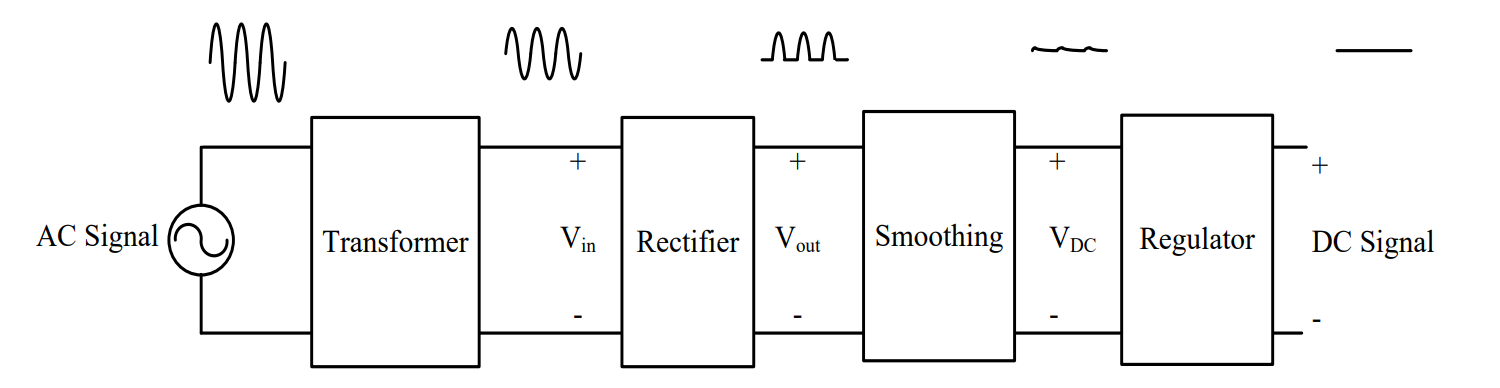
Figure 8: The steps in the AC-to-DC conversion process
For the rest of this lesson, this process will be displayed as a block diagram. The “XFMR” block will represent the transformation step, and a “AC/DC” Block will represent rectification, smoothing, and regulation. If a half-wave rectifier and capacitor were used with a transformer in an AC-DC converter design, the design could be represented using a block diagram, schematic, or combination of both, as shown in . In this case, the AC-DC converter is in series with the transformer.

Figure 9: Block diagram of AC-to-DC conversion process
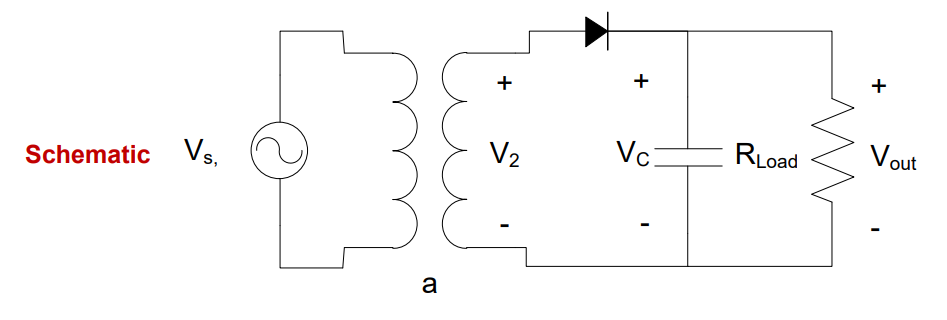
Figure 10: Schematic of AC-to-DC conversion process
Example Problem 1#
The AC signal, v(t) = 169.7cos(360° × 1kt) V is input into an ideal half-wave rectifier with a 10:1 turns ratio transformer. What is the DC output, neglecting the ripple?
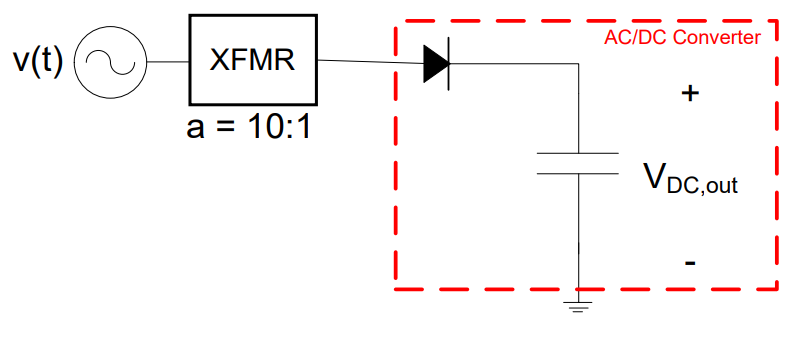
Understand: We will need to step down the voltage before solving for our final DC output.
Identify Key Information:
Knowns: The input AC voltage, frequency, and the turns ratio of the transformer.
Unknowns: The output voltage, VDC,out
Assumptions: We are dealing with an ideal transformer.
Plan: We can use the turns ratio to determine the input voltage to the AC-DC converter, then because the converter is not loaded, the output voltage will be equal to the input voltage.
Solve: The input voltage is stepped down by the transformer:
Since the converter is unloaded, the DC voltage coming out of the converter is then the peak voltage of the signal going into the converter:
Answer: The DC output from the AC-to-DC Converter is 16.97 V.
Example Problem 2#
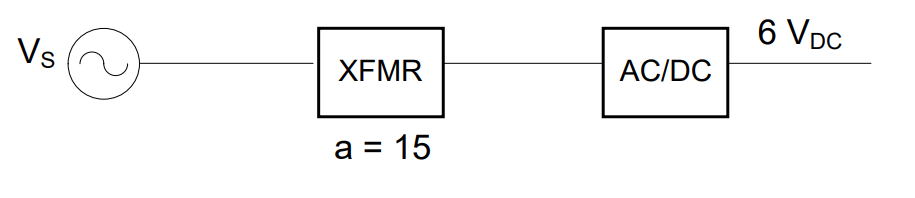
Assume the AC/DC block below is limited to the rectification, smoothing and regulation stages, and the required input should be 8V. Given a source voltage \(v_{s}(t) = 120\cos(360{^\circ} \times 60t)V\), determine the turns ratio of the transformer to make the circuit work.
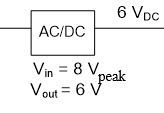
Understand: This is very similar to the previous problem, as we will need a transformer to step down the voltage, but we notice the output of the converter is not quite equal to the peak input signal. This is a much more realistic problem than the first example. We will actually have to work backwards to decide what kind of transformer is needed.
Identify Key Information:
Knowns: We know the source voltage and the input and output voltages of the converter.
Unknowns: The turns ratio of the transformer.
Assumptions: Since the output voltage of the converter is less than the peak input, we assume the AC-DC converter is inefficient.
Plan: Since we know the basic design for our AC-DC converter, we draw the following block diagram:
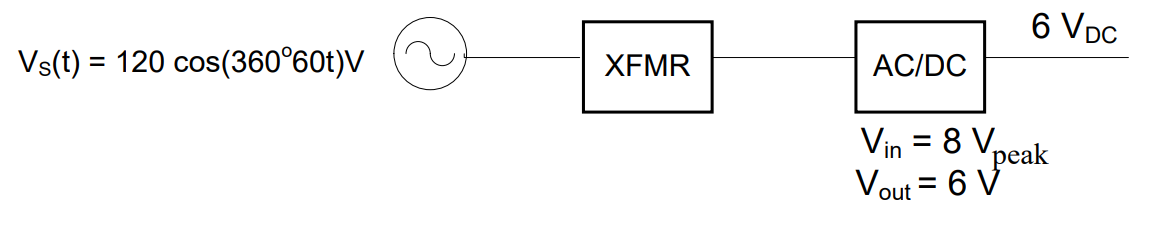
The key to this problem is realizing the peak voltages will be used to determine the turns ratio. These voltages could be given, like the input of the AC-DC converter (8V), or provided in an equation, like the input (vS(t)). However, the bottom line is that the transformer has to step the 120V signal down to 8V. The AC-DC converter will then change it to 6VDC. This means we will need to use the input voltage of the converter to determine the output voltage of the transformer. Then, we will use the turns ratio equation.
Solve: We determine the turns ratio of the transformer using the peak voltages of the components:
Answer: The design to convert 120 cos(360⁰ * 60t) V to 6VDC is:
B. DC-DC Converters#
DC-DC converters adjust the voltage level of a DC power source. They are commonly used in battery-operated devices, electric vehicles, and renewable energy systems.
Types of DC-DC converters include:
Buck Converters (Step-Down): Reduce voltage from a higher DC level to a lower one.
Boost Converters (Step-Up): Increase voltage from a lower DC level to a higher one.
Buck-Boost Converters: Capable of both increasing and decreasing voltage, depending on circuit design.
These converters help regulate power distribution efficiently while minimizing energy losses.
C. DC-AC Converters (Inverters)#
DC-AC converters, also known as inverters, convert DC power into AC power. This conversion is critical for applications such as:
Solar power systems, where DC energy from solar panels is converted into AC for home use.
Uninterruptible power supplies (UPS) that provide backup power.
Motor drive systems and industrial automation.
Inverters vary in their output waveform quality, including square wave, modified sine wave, and pure sine wave inverters, with pure sine wave inverters providing the best efficiency and compatibility with AC devices.
D. AC-AC Converters#
For the purposes of ECE 215, we will assume any AC-AC converter is simply a transformer, which we learned about in the previous lesson. However, besides just modifying the voltage of an AC signal, AC-AC converters can also modify the frequency. These types of AC-AC converters are commonly used in applications such as:
Voltage regulators that stabilize power supply fluctuations.
Frequency converters that adapt electrical devices to different grid frequencies (e.g., 50Hz to 60Hz).
Variable frequency drives (VFDs) that control the speed of AC motors in industrial settings.
4. Factors to Consider When Selecting Power Converters#
When choosing a power converter, engineers must consider several factors to ensure compatibility and efficiency:
A. Efficiency#
Power conversion inevitably leads to some energy loss as heat. Higher efficiency converters minimize these losses, improving energy savings and reducing the need for cooling mechanisms.
B. Power Rating#
The power converter must match the voltage and current requirements of the application. Exceeding the rated capacity can cause overheating and failure.
C. Size and Weight#
Compact converters are desirable for portable electronics and space-constrained applications, whereas industrial systems may prioritize performance over size.
D. Output Stability and Regulation#
Stable voltage and current output are critical for sensitive electronics. High-quality converters incorporate feedback mechanisms to maintain consistent output under varying loads.
E. Thermal Management#
Converters generate heat during operation. Efficient thermal dissipation mechanisms, such as heat sinks and cooling fans, are necessary to maintain performance and longevity.
F. Environmental and Safety Considerations#
Power converters must comply with safety standards and environmental regulations. Isolation features prevent electrical hazards, while rugged designs ensure operation in harsh conditions.
5. Applications of Power Converters#
Power converters are found in nearly every modern electrical system. Some key applications include:
Consumer Electronics: Laptops, smartphones, gaming consoles, and home appliances.
Electric Vehicles (EVs): Battery charging and power management in hybrid and fully electric vehicles.
Renewable Energy Systems: Converting and distributing energy from solar panels and wind turbines.
Telecommunications: Powering cell towers and network infrastructure.
Industrial Automation: Motor control, robotics, and automated machinery.
Medical Equipment: Reliable power supply for critical devices like MRI machines and ventilators.
Conclusion#
Power converters are indispensable in modern electrical and computer engineering, ensuring that electrical energy is efficiently transformed to meet the needs of different applications. Understanding the principles, types, and selection criteria of power converters is essential for designing reliable and efficient power systems.